Supporting Information for the work presented in: Brylinski
M, Skolnick J. (2008) Q-Dock: low-resolution flexible ligand docking with
pocket-specific threading restraints. J Comput Chem, in press.
[Abstract]
PDB-ID: PDB code and chain identifier of the target receptor protein.
Threading templates: Weakly homologous structure templates identified by PROSPECTOR_3 used to generate theoretical receptor models by TASSER and to predict ligand binding sites by FINDSITE. Z-score and PDB-ID of the top-ranked template is given.
Protein model: Theoretical model used as a target for ligand docking. RMSD from the crystal structure is calculated for CA atoms.
*.all.pdb.gz - all-atom coordinates.
*.cas.pdb.gz - coordinates for the simplified model (CA atoms and side chains centers of mass).
FINDSITE pockets: The results of ligand binding site prediction for protein models using FINDSITE.
*.findsite.dat - centers of predicted pockets. Top-ranked prediction was used by Q-Dock.
[data format] *.potential.dat - pocket-specific protein-ligand interaction potential for top-ranked FINDSITE pocket derived from ligand-bound threading templates.
[data format]
Q-Dock (EGEN): The results of flexible ligand docking by Q-Dock employing the generic force field (EGEN). Final docked energy and simulation time (2.0GHz Opteron CPU) is given.
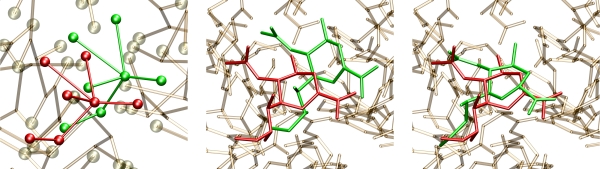
*.Q-Dock_GEN.pdb - top-ranked low-resolution docking image generated by Q-Dock.
[data format] *.rebuilt_GEN.pdb - all-atom model rebuilt from the low-resolution image.
Q-Dock (ETOT): The results of flexible ligand docking by Q-Dock employing the generic force field combined with the pocket-specific restraints (ETOT). Final docked energy and simulation time (2.0GHz Opteron CPU) is given.
*.Q-Dock_TOT.pdb - top-ranked low-resolution docking image generated by Q-Dock.
[data format] *.rebuilt_TOT.pdb - all-atom model rebuilt from the low-resolution image.